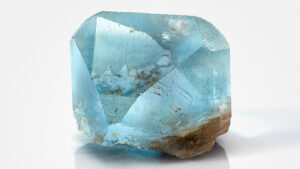
As autumn gives way to winter, November claims two of the most radiant gemstones in the mineral kingdom: Topaz and Citrine. While traditional lore celebrates these gems in warm shades of sherry, honeyed amber, and imperial peach, modern clients are often surprised to learn how a 20th-century scientific breakthrough caused the world to fall in love with topaz of an entirely different hue: electric blue.
Origin: How Topaz, Citrine, and the “Blue Shift” Came to Be
November’s historical connection centered on warm golden stones known in antiquity under the Greek name topazos. When the American National Retail Jewelers Association (now Jewelers of America) codified the official modern birthstone list in 1912, they cemented Topaz—specifically in its natural yellow and orange varieties—as November’s signature gem.
1952 (The Citrine Addition): Because fine, natural imperial topaz was scarce and commanded high prices, the industry added Citrine—the golden variety of quartz—as an accessible, durable sister stone sharing November’s rich autumnal palette.
The 1970s “Blue Shift”: Naturally occurring blue topaz is extraordinarily pale and rare. In the 1970s, gemological researchers discovered that subjecting abundant colorless topaz to irradiation and heat treatment could produce vivid Sky, Swiss, and deep London Blue hues. The market was flooded with affordable, brilliant blue gems. Because consumers knew “Topaz” as November’s gem, many began buying blue topaz for November—even though trade associations formally placed blue topaz on the December list. Today, fine jewelers embrace both palettes: warm golden-orange for tradition, and vibrant blue for everyday modern flair.
Fascinating Facts
- The Great Diamond Impostor: In 1740, an extraordinary 1,680-carat clear gemstone was discovered in Minas Gerais, Brazil, and mounted into the Portuguese crown jewels as the famed “Braganza Diamond.” Centuries later, gemological analysis revealed it wasn’t a diamond at all, but an exceptional colorless topaz.
- The Romanov Imperial Monopoly: The rarest natural variety—Imperial Topaz, displaying a reddish-cognac to peachy-pink hue—was discovered in Russia’s Ural Mountains in the 19th century. Czarist decree mandated that all top-grade stones mined there were reserved exclusively for the Romanov Imperial family.
- Sunlight Trapped in Quartz: Citrine derives its name from the Old French citron (lemon). While natural citrine owes its golden color to ferric iron inclusions, natural specimens are remarkably scarce; the vast majority of commercial citrine is created by heating natural amethyst to roughly 450°C (842°F).
- The Static Charge Trick: Topaz is naturally pyroelectric and piezoelectric. When rubbed vigorously or exposed to temperature shifts, it generates an electrostatic charge strong enough to attract and pick up small scraps of paper, a curiosity that fascinated 18th-century naturalists.
- True Blue Texan: While natural blue is exceedingly rare, Texas is one location with natural blue deposits, specifically Mason County. It became such an important and rare stone that Texas declared Mason Country Blue Topaz the state gem in 1969.
Legendary & Historically Significant Jewelry
- The Smithsonian’s American Golden Topaz: Weighing an astonishing 22,892.5 carats (over 10 pounds), this 172-facet marvel sourced from Minas Gerais, Brazil, remains one of the largest faceted gemstones in the world. Lapidary artist Leon Agee spent two meticulous years faceting the massive crystal.
- The Art Deco Citrine Renaissance: Citrine reached peak acclaim during the 1920s and 1930s Art Deco movement. Legendary jewelry houses like Cartier, Van Cleef & Arpels, and Trabert & Hoeffer-Mauboussin embraced citrine’s massive crystal sizes, carving geometric emerald and trapeze cuts into monumental cocktail rings and convertible clip brooches favored by icons like Greta Garbo and Joan Crawford.
- Queen Marie of Romania’s Royal Sautoir: Queen Marie was celebrated for her bold, theatrical aesthetic, famously commissioning a dramatic Art Deco sautoir by Cartier that highlighted monumental golden beryls and rich imperial topaz drop pendants.
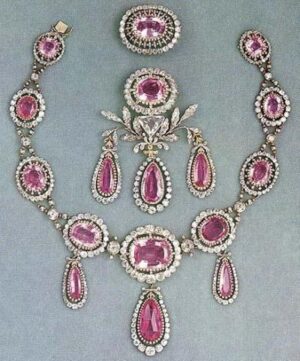

Swedish Pink Topaz Parure